Gol-e-Zard Cave lies in the shadow of Mount Damavand, which at more than 5,000 metres dominates the landscape of northern Iran. In this cave, stalagmites and stalactites are growing slowly over millennia and preserve in them clues about past climate events. Changes in stalagmite chemistry from this cave have now linked the collapse of the Akkadian Empire to climate changes more than 4,000 years ago.
Akkadia was the world’s first empire. It was established in Mesopotamia around 4,300 years ago after its ruler, Sargon of Akkad, united a series of independent city states. Akkadian influence spanned along the Tigris and Euphrates rivers from what is now southern Iraq, through to Syria and Turkey. The north-south extent of the empire meant that it covered regions with different climates, ranging from fertile lands in the north which were highly dependent on rainfall (one of Asia’s “bread baskets”), to the irrigation-fed alluvial plains to the south.
The Akkad empire during the reign of Narâm-Sîn (2254-2218 BC). Mount Damavand is labelled in blue. Zunkir / Semhir / wiki, CC BY-SA
It appears that the empire became increasingly dependent on the productivity of the northern lands and used the grains sourced from this region to feed the army and redistribute the food supplies to key supporters. Then, about a century after its formation, the Akkadian Empire suddenly collapsed, followed by mass migration and conflicts. The anguish of the era is perfectly captured in the ancient Curse of Akkad text, which describes a period of turmoil with water and food shortages:
… the large arable tracts yielded no grain, the inundated fields yielded no fish, the irrigated orchards yielded no syrup or wine, the thick clouds did not rain.
Drought and dust
The reason for this collapse is still debated by historians, archaeologists and scientists. One of the most prominent views, championed by Yale archaeologist Harvey Weiss (who built on earlier ideas by Ellsworth Huntington), is that it was caused by an abrupt onset of drought conditions which severely affected the productive northern regions of the empire.
Sargon of Akkad – or maybe his son, Naram-Sin. Iraqi Directorate General of Antiquities / wiki
Weiss and his colleagues discovered evidence in northern Syria that this once prosperous region was suddenly abandoned around 4,200 years ago, as indicated by a lack of pottery and other archaeological remains. Instead, the rich soils of earlier periods were replaced by large amounts of wind-blown dust and sand, suggesting the onset of drought conditions. Subsequently, marine cores from the Gulf of Oman and the Red Sea which linked the input of dust into the sea to distant sources in Mesopotamia, provided further evidence of a regional drought at the time.
Many other researchers viewed Weiss’s interpretation with scepticism, however. Some argued, for example, that the archaeological and marine evidence was not accurate enough to demonstrate a robust correlation between drought and societal change in Mesopotamia.
A new detailed climate record
Now, stalagmite data from Iran sheds new light on the controversy. In a study published in the journal PNAS, led by Oxford palaeoclimatologist Stacy Carolin, colleagues and I provide a very well dated and high resolution record of dust activity between 5,200 and 3,700 years ago. And cave dust from Iran can tell us a surprising amount about climate history elsewhere.
Gol-e-Zard Cave might be several hundred miles to the east of the former Akkadian Empire, but it is directly downwind. As a result, around 90% of the region’s dust originates in the deserts of Syria and Iraq.
Mount Damavand is a ‘potentially active’ volcano, and the highest peak in Iran. Gol-e-Zard Cave is nearby. Vasile Ersek, Author provided
That desert dust has a higher concentration of magnesium than the local limestone which forms most of Gol-e-Zard’s stalagmites (the ones which grow upwards from the cave floor). Therefore, the amount of magnesium in the Gol-e-Zard stalagmites can be used as an indicator of dustiness at the surface, with higher magnesium concentrations indicating dustier periods, and by extension drier conditions.
The stalagmites have the additional advantage that they can be dated very precisely using uranium-thorium chronology. Combining these methods, our new study provides a detailed history of dustiness in the area, and identifies two major drought periods which started 4,510 and 4,260 years ago, and lasted 110 and 290 years respectively. The latter event occurs precisely at the time of the Akkadian Empire’s collapse and provides a strong argument that climate change was at least in part responsible.
The collapse was followed by mass migration from north to south which was met with resistance by the local populations. A 180km wall – the “Repeller of the Amorites” – was even built between the Tigris and Euphrates in an effort to control immigration, not unlike some strategies proposed today. The stories of abrupt climate change in the Middle East therefore echo over millennia to the present day.
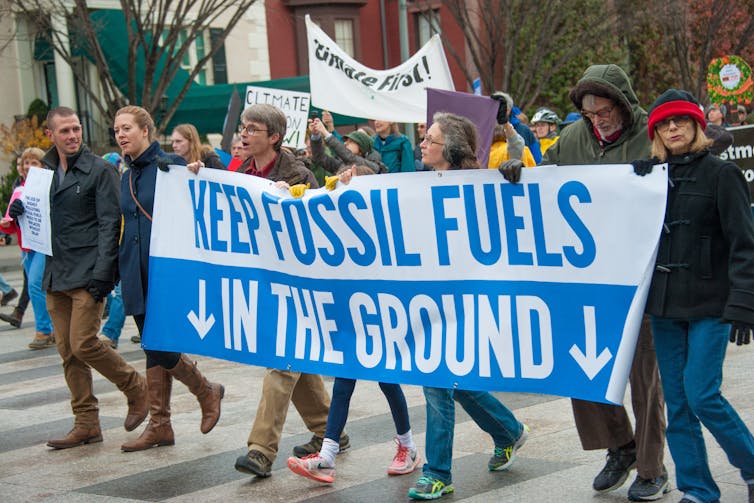
The global strike on Friday September 20, 2019 was the largest demonstration for climate action in history. The movement that started with Swedish teenager Greta Thunberg in August 2018 has now mobilised millions, while Extinction Rebellion and other protest groups have escalated their campaigns on streets around the world. From the efforts of activists in different countries, radical “Green New Deals” are emerging as a bold, political response to the climate crisis.
“The world is waking up,” Thunberg told world leaders at the recent UN Climate Action Summit. “And change is coming whether you like it or not.”
But how long that awakening takes could be decisive for warming this century. A report published ahead of the summit declared that the impacts of climate change are accelerating – global emissions of carbon dioxide (CO₂) grew by 20% between 2015 and 2019, while the average rate of sea level rise has increased to 5mm per year over roughly the same period.
Predicted sea level rise this century if warming reaches 2.6°C, 4.5°C or 8.5°C by 2100. IPCC, Author provided
One author warned that limiting global temperature rise to 2°C would require tripling current commitments to reduce emissions. To hold temperatures at 1.5°C above pre-industrial levels, global ambition would need to increase by a factor of five.
The debate over whether climate change is happening is over, and the conversation about what should be done is beginning in earnest. As such, for the past few weeks, we’ve asked experts from around the world to describe how the world should respond to the threat of climate breakdown. We share their insights here.
The state of the Earth
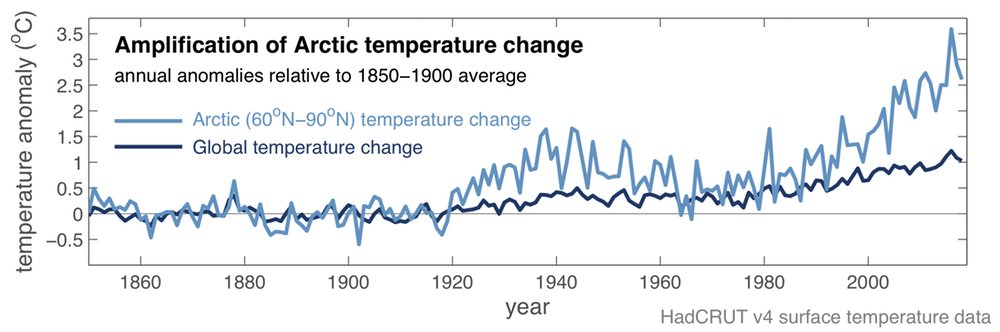
Nowhere are the effects of climate change more visible than in the Arctic – a region that’s estimated to be warming at least twice as fast as the global average. Arctic sea ice reached its second-lowest extent on record in September 2019 – a mere 1.6m square miles.
A new report by the Intergovernmental Panel on Climate Change (IPCC) has revealed the changes that are underway in the oceans and the ice-covered regions of the world, and the message is stark.
“Glaciers and ice sheets are shrinking. Global sea level is rising at more than twice the rate of the 20th century. The ocean is warming, becoming more acidic and losing oxygen. Fifty percent of coastal wetlands have been lost over the past 100 years. Species are shifting, biodiversity is declining and ecosystems are losing their integrity and function.”
– Cassandra Brooks, University of Colorado Boulder
Wildlife populations are struggling to adapt to the disruption, both in the oceans and on land. As a result, a landmark report from an international team of biodiversity experts earlier in 2019 called for “transformative change” to economies and societies to prevent up to a million species going extinct.
Five steps to restrain emissions right now
“The UK, Norway, Sweden and France have written a target of net-zero emissions into law, [but] targets are, by definition, a statement of nothing more than intent. In and of themselves, they do not remove a single molecule of carbon dioxide from the atmosphere.”
– Rebecca Willis, Lancaster University
Limiting global temperature rise to 1.5°C means the world has to be at net-zero carbon emissions by 2050. But it’s cumulative emissions that count – if countries leave decarbonisation until the last minute, it will be too late. Rebecca Willis, a professor of climate and energy policy at Lancaster University in the UK, outlines five measures that can begin to restrain emissions right now:
Task all government departments with a climate agenda so that they’re obligated to show how their policies will contribute to emissions cuts.
Engage the public in developing climate strategies with citizens’ assemblies and involve workers in designing policy to ensure a “just transition” from carbon-intensive industries like coal mining.
Enact “symbolic policies” to set the investment climate and catalyse radical change – ban advertising for petrol cars for instance, or allow people to generate and sell renewable energy at home.
Tree species that grow fast are able to store carbon more rapidly, but slower, bigger trees will ultimately store more in the long run.
Non-native trees may be better at absorbing carbon efficiently than native species, so keep an open mind to their role.
When choosing a species to plant, trust local foresters and the community that will have to live alongside and nurture them.
Natural climate solutions can also help society adapt to the inevitable changes ahead. Zita Sebesvari, head of environmental vulnerability and ecosystem services at United Nations University, argues that the value of rewilding here is two-fold: removing the CO₂ that exacerbates climate change while mitigating its impacts.
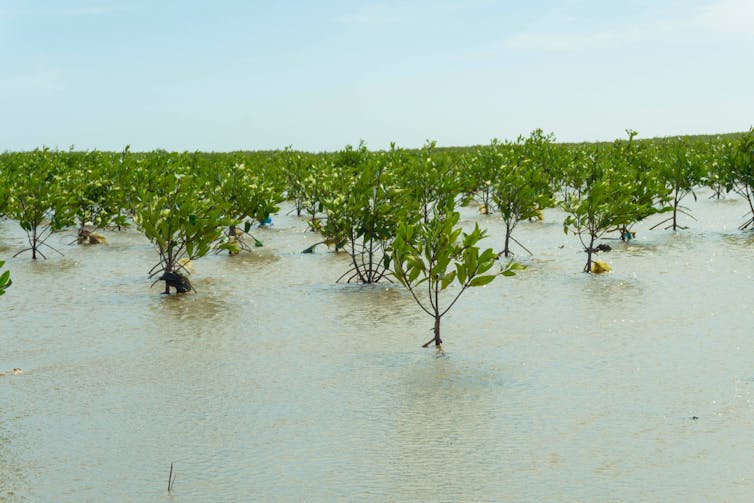
Coastal wetlands, marshes and mangrove swamps can retain sediments and can grow vertically at rates equal to or greater than the mean rate of sea level rise. These habitats can also accumulate carbon 40 times quicker per hectare than tropical forests.
Replanting mangroves could protect tropical coastlines from flooding and storm surges, while absorbing atmospheric carbon and slowing climate change at the same time. Janine Kandel/UNU-EHS, Author provided
Farming for meat and dairy can use up to 100 times the land area to produce a single gram of protein compared to beans, nuts and other plant sources. Little wonder that people are encouraged to eat less of it, and Alessandro Demaio, a fellow in global health at the University of Copenhagen, recommends a “planetary health diet” which involves reducing meat intake in Western countries by 50%. He also calls for:
Recycling organic waste as fertiliser and investing in agroforestry – where trees are grown around crops to increase biodiversity.
Breeding drought-resistant crop strains, making animal feed more nutritious and creating additives that can make livestock emit 30% less methane.
Reducing food waste and restoring land and ocean habitats.
Sean Beer, a lecturer in agriculture at Bournemouth University, argues that eating more local and seasonal produce could go some way to decarbonising agriculture.
Reviving traditional food supply systems may also be key to guaranteeing sustainable diets for all, says Jagannath Adhikari, a sessional lecturer at the University of New South Wales.
More than 820m people suffer from hunger, and about two billion people face moderate food insecurity – meaning they do not always know when their next meal will come. After a decade of slow decline, climate change is driving this number up again, particularly in Africa and Asia, where competition over land for both farming and forest conservation is acute.
In parts of the Himalayas, the answer to this problem is “food forests”. Local people plant useful trees and grow crops in the woodland near their homes, and protect what grows there naturally. They harvest what they need – mushrooms, honey, roots and edible plants – and sell any surplus at a market. Since community rights were restored to forest management here, worrying trends in deforestation and poverty have been reversed.
A woman sells bamboo shoots in Pokhara, Nepal. These bamboo shoots are collected in forests at high altitude, 2,200-2,600 metres above sea level. Jagannath Adhikari
The idea was born in the UK in 2007, but has been gaining ground around the world lately, especially in the US where it has been championed by congresswoman Alexandria Ocasio-Cortez. Although the specifics vary, a Green New Deal involves large investments in clean energy sector jobs and infrastructure to decarbonise the economy and correct inequalities through job guarantees and universal basic services such as free public transport and healthcare. Governments would also be expected to slash or eliminate the billions they spend on subsidising the cost of fossil fuels.
>“If governments respond appropriately to the urgent warning issued by the Intergovernmental Panel on Climate Change (IPCC) in October [2018], efforts to phase out fossil fuels will have to ramp up considerably — and quickly.”
– Kyla Tienhaara, Queen’s University, Canada
Already, there has been a slew of lawsuits against the largest fossil fuel companies in an effort to hold them accountable for misleading the public on the risks of climate change while selling products that have contributed to it. Litigation, thus far, has not been successful, but the tide may be turning.
In the US, more than a dozen cities, counties and states are seeking damages from energy companies for the the costs of climate change, from retrofitting storm drains to upgrading sea walls. These lawsuits draw on litigation against tobacco companies and on scientific research that attributes greenhouse gas emissions to energy companies.
In the past, “the plaintiffs had difficulties tracing climate harms to specific emissions made by particular corporations … Scientific research has evolved dramatically since then.” says Lisa Benjamin, from Lewis & Clark College of Law, in Portland, Oregon.
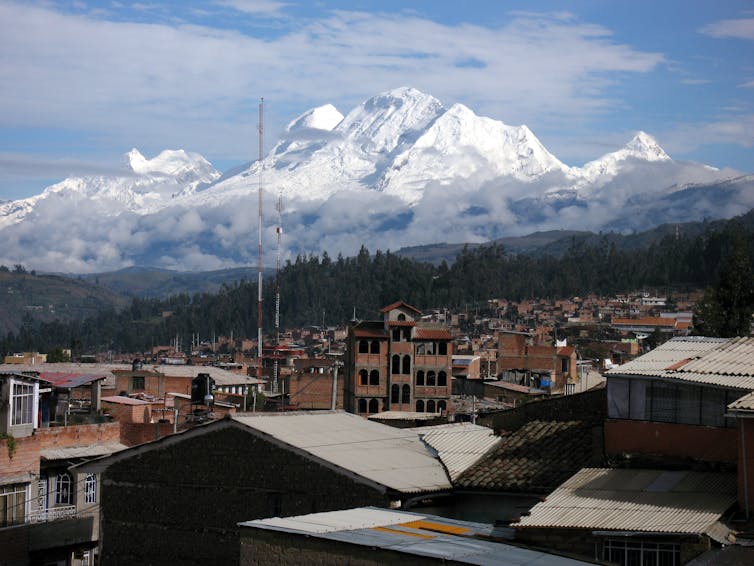
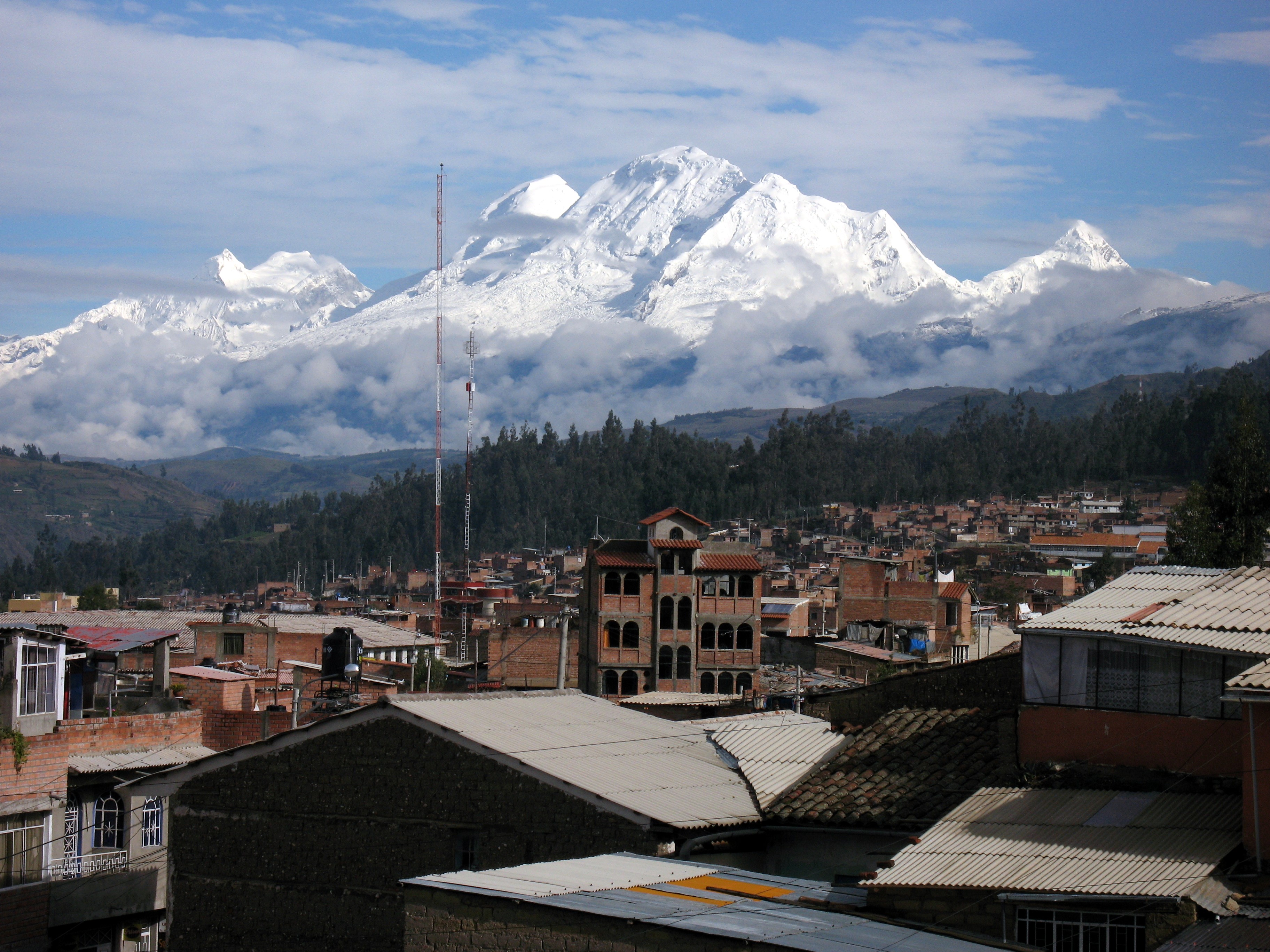
For example, in Europe, a German court has agreed to hear a Peruvian farmer’s case against the German energy giant RWE for its role in melting the glaciers near his hometown of Huaraz and raising the risks of landslides and flooding. A study found RWE was responsible for 0.47% of historic emissions, so the farmer is seeking 0.47% of the cost for his community to adapt to climate change.
As the impacts of climate change become more clear, Thunberg’s not the only one questioning the “fairy tales of eternal economic growth”. Producing stuff consumes energy, and producing more stuff, whether it’s fast fashion or smartphones, means the ongoing and growing consumption of energy.
“This makes it very hard to decarbonise the economy,” says Simon Mair at the University of Surrey. If we stopped chasing productivity growth, decarbonisation would come easier, we’d have less “crap” and we might start investing time and human energy into good jobs that matter, like teaching and nursing.
The media is finally listening to the experts
Despite the potentially massive implications of a 2°C rise in global temperature, climate change has remained low on the news agenda. Journalists and their news organisations have largely failed to give climate change the attention it deserves and have failed to press political figures on climate issues and policies.
Years ago, climate journalists threw away the notion of putting scientific fact and climate denier opinion on equal ground. Other media are finally catching up and providing analysis and verification, and improving the scientific literacy of their audience. They are connecting climate change to local stories, focusing on solutions (instead of “doom and gloom” coverage) and adjusting their language to describe the “climate crisis”.
These shifts in journalism may yield more action on climate change. Young people tend to avoid negative news headlines; they don’t want their climate coverage to present a bleak and certain future. Instead, they want stories about the “system change” necessary to create zero-carbon societies, says Julie Doyle, from the University of Brighton. It’s not that they can’t handle the bad news, but that “they wanted to be involved in rethinking socioeconomic systems, and are inspired and empowered by working together.”
That’s why “system change not climate change” has became the rallying cry of the young climate strikers. Thunberg’s journey from a lonely vigil outside the Swedish parliament to a Nobel Peace Prize nominee at the head of a global movement took just over a year. It seems the world really is waking up, but now comes the hard part – changing the systems that fuel the climate crisis before it’s too late.
The science of climate change is more than 150 years old and it is probably the most tested area of modern science. However the energy industry, political lobbyists and others have spent the last 30 years sowing doubt about the science where none really exists. The latest estimate is that the world’s five largest publicly-owned oil and gas companies spend about US$200m each year on lobbying to control, delay or block binding climate-motivated policy.
This organised and orchestrated climate change science denial has contributed to the lack of progress in reducing global green house gas (GHG) emissions - to the point that we are facing a global climate emergency. And when climate change deniers use certain myths – at best fake news and at worse straight lies – to undermine the science of climate change, ordinary people can find it hard to see through the fog. Here are five commonly used myths and the real science that debunks them.
1. Climate change is just part of the natural cycle
The climate of the Earth has always changed, but the study of palaeoclimatology or “past climates” shows us that the changes in the last 150 years – since the start of the industrial revolution – have been exceptional and cannot be natural. Modelling results suggest that future predicted warming could be unprecedented compared to the previous 5m years.
Global temperatures for the last 65m years and possible future global warming depending on the amount of greenhouse gases we emit. Burke et al (2018)
The “natural changes” argument is supplemented with the story that the Earth’s climate is just recovering from the cooler temperatures of the Little Ice Age (1300-1850AD) and that temperatures today are really the same as the Medieval Warm Period (900–1300AD). The problem is that both the Little Ice Age and the Medieval Warming period were not global but regional changes in climate affecting north-west Europe, eastern America, Greenland and Iceland.
A study using 700 climate records showed that, over the last 2,000 years, the only time the climate all around the World has changed at the same time and in the same direction has been in the last 150 years, when over 98% of the surface of the planet has warmed.
2. Changes are due to sunspots/galactic cosmic rays
Sunspots are storms on the sun’s surface that come with intense magnetic activity and can be accompanied by solar flares. These sunspots do have the power to modify the climate on Earth. But scientists using sensors on satellites have been recording the amount of the sun’s energy hitting Earth since 1978 and there has been no upward trend. So they cannot be the cause of the recent global warming.
A comparison of global surface temperature changes (red line) and the sun’s energy received by the Earth (yellow line) in watts (units of energy) per square metre since 1880. NASA, CC BY
Galactic cosmic rays (GCRs) are high-energy radiation that originates outside our solar system and may even be from distant galaxies. It has been suggested that they may help to seed or “make” clouds. So reduced GCRs hitting the Earth would mean fewer clouds, which would reflect less sunlight back into space and so cause Earth to warm.
But there are two problems with this idea. First, the scientific evidence shows that GCRs are not very effective at seeding clouds. And second, over the last 50 years, the amount of GCRs have actually increased, hitting record levels in recent years. If this idea were correct, GCRs should be cooling the Earth, which they aren’t.
3. CO₂ is a small part of the atmosphere – it can’t have a large heating affect
Eunice Newton Foote’s paper, Circumstances Affecting the Heat of the Sun’s Rays, American Journal of Science, 1857.
This is an attempt to play a classic common-sense card but is completely wrong. In 1856, American scientist Eunice Newton Foote conducted an experiment with an air pump, two glass cylinders and four thermometers. It showed that a cylinder containing carbon dioxide and placed in the sun trapped more heat and stayed warmer longer than a cylinder with normal air. Scientists have repeated these experiments in the laboratory and in the atmosphere, demonstrating again and again the greenhouse effect of carbon dioxide.
As for the “common sense” scale argument that a very small part of something can’t have much of an effect on it, it only takes 0.1 grams of cyanide to kill an adult, which is about 0.0001% of your body weight. Compare this with carbon dioxide, which currently makes up 0.04% of the atmosphere and is a strong greenhouse gas. Meanwhile, nitrogen makes up 78% of the atmosphere and yet is highly unreactive.
4. Scientists manipulate all data sets to show a warming trend
This is not true and a simplistic device used to attack the credibility of climate scientists. It would require a conspiracy covering thousands of scientists in more than a 100 countries to reach the scale required to do this.
Scientists do correct and validate data all the time. For example we have to correct historic temperature records as how they were measured has changed. Between 1856 and 1941, most sea temperatures were measured using seawater hoisted on deck in a bucket. Even this was not consistent as there was a shift from wooden to canvas buckets and from sailing ships to steamships, which altered the height of the ship’s deck – and these changes in turn altered the amount of cooling caused by evaporation as the bucket was hoisted onto deck. Since 1941, most measurements have been made at the ship’s engine water intakes, so there’s no cooling from evaporation to account for.
We must also take account that many towns and cities have expanded and so that meteorological stations that were in rural areas are now in urban areas which are usually significantly warmer than the surrounding countryside.
If we didn’t make these changes to the original measurements, then Earth’s warming over the last 150 years would have appeared to be even greater than the change that has actually been observed, which is now about 1˚C of global warming.
Reconstruction of global temperatures from 1880 to 2018 by five independent international groups of scientists. NASA, CC BY
5. Climate models are unreliable and too sensitive to carbon dioxide
This is incorrect and misunderstands how models work. It is a way of downplaying the seriousness of future climate change. There is a huge range of climate models, from those aimed at specific mechanisms such as the understanding of clouds, to general circulation models (GCMs) that are used to predict the future climate of our planet.
There are over 20 major international centres where teams of some of smartest people in the world have built and run GCMs containing millions of lines of code representing the very latest understanding of the climate system. These models are continually tested against historic and palaeoclimate data as well as individual climate events such as large volcanic eruptions to make sure they reconstruct the climate, which they do extremely well.
Model reconstruction of global temperature since 1970, average of the models in black with model range in grey compared to observational temperature records from NASA, NOAA, HadCRUT, Cowtan and Way, and Berkeley Earth. Carbon Brief, CC BY
No single model should ever be considered correct as they represent a very complex global climate system. But having so many different models constructed and calibrated independently means that we can have confidence when the models agree.
Taking the whole range of climate models suggests a doubling of carbon dioxide could warm the planet by 2˚C to 4.5˚C, with an average of 3.1˚C. All the models show a significant amount of warming when extra carbon dioxide is added to the atmosphere. The scale of the predicted warming has remained very similar over the last 30 years despite the huge increase in the complexity of the models, showing it is a robust outcome of the science.
By combining all our scientific knowledge of natural (solar, volcanic, aerosols and ozone) and human-made (greenhouse gases and land-use changes) factors warming and cooling the climate shows that 100% of the warming observed over the last 150 years is due to humans.
Natural and Human influences on global temperatures since 1850. Carbon Brief, CC BY
There is no scientific support for the continual denial of climate change. The Intergovernmental Panel on Climate Change (IPCC), set up by the United Nations to openly and transparently summarise the science, provides six clear lines of evidence for climate change. As extreme weather becomes more and more common, people are realising that they do not need scientists to tell them the climate is changing – they are seeing and experiencing it first hand.
This is a concerted effort among news organisations to put the climate crisis at the forefront of our coverage. This article is published under a Creative Commons license and can be reproduced for free – just hit the “Republish this article” button on the page to copy the full HTML coding. The Conversation also runs Imagine, a newsletter in which academics explore how the world can rise to the challenge of climate change. Sign up here